
Accounting Basics
A complete guide to accounting basics for pharmacy owners. Learn about assets, liabilities, debits, credits, GST, and how MediFlux organizes your books.
Accounting is the language of business. It is the system of recording, classifying, and summarizing every financial transaction so you understand exactly how your pharmacy is performing. Whether you are tracking daily sales, paying suppliers, or filing GST returns, accounting gives you the clarity to make informed decisions.
You do not need to be a chartered accountant to use MediFlux. The software automates most entries behind the scenes. This guide exists so you can read your reports with confidence and catch problems early.
What you will learn
- How the accounting equation keeps your books balanced
- What assets, liabilities, equity, income, and expenses actually mean in a pharmacy
- The golden rules of debit and credit
- How MediFlux structures your Chart of Accounts
- How GST flows through your books
- The difference between profit and cash flow
- How to read your core financial statements
The accounting equation
Every transaction in your pharmacy follows one immovable rule:
Assets = Liabilities + Equity
This equation is the foundation of double-entry bookkeeping. Everything your business owns (Assets) is funded either by what you owe to others (Liabilities) or by what belongs to the owners (Equity).
If this equation is ever out of balance, there is an error in your books. Your Trial Balance exists specifically to catch this.
The five building blocks
All accounting boils down to five categories. Every account in your Chart of Accounts falls into one of these.
1. Assets
Assets are things your business owns that have value. MediFlux divides assets into two types based on how quickly they can be converted to cash.
Current Assets (convertible to cash within one year):
Non-Current Assets (held for more than one year):
In MediFlux, Drug Inventory and Non-Drug Inventory values are calculated automatically from your purchase and sale records.
2. Liabilities
Liabilities are what your business owes to others. They are grouped by how soon they must be paid.
Current Liabilities (due within one year):
Non-Current Liabilities (due after one year):
3. Equity
Equity is the owner's stake in the business.
When you first set up MediFlux Accounting, you enter your Owner Capital. The system then calculates Retained Earnings automatically to make the equation balance.
4. Income (Revenue)
Income is money earned from your primary business activities.
- Cash sales at the counter
- Credit sales to customers
- Sales of non-drug items
- Service income (consultations, health checks)
5. Expenses
Expenses are costs incurred to run the business.
- Purchase of medicines and stock
- Rent, salaries, electricity
- Transportation and courier charges
- Marketing and advertising
The difference between total income and total expenses is your Net Profit or Net Loss. This is what your P&L Statement shows.
Debit and Credit
Debit and Credit are not simply "plus" and "minus". They are directions. Whether a debit increases or decreases an account depends on the account type.
The golden rules
How debits and credits affect each account type
Debits and Credits always balance
Every journal entry must have equal debits and credits. If you debit one account by ₹1,000, you must credit another account by exactly ₹1,000. This is why it is called double-entry bookkeeping.
A simple example
You sell medicines for ₹500 cash:
You sell medicines for ₹1,200 on credit to a customer:
You buy stock worth ₹10,000 on credit from a supplier:
You buy stock worth ₹5,000 and pay immediately by cash:
Ledgers
The Ledgers is the master list of every account your pharmacy uses. Think of it as the filing cabinet for your financial data.
MediFlux organizes accounts into parent groups and child accounts. Parent groups are categories. Child accounts are the actual accounts used in transactions.
Parent groups
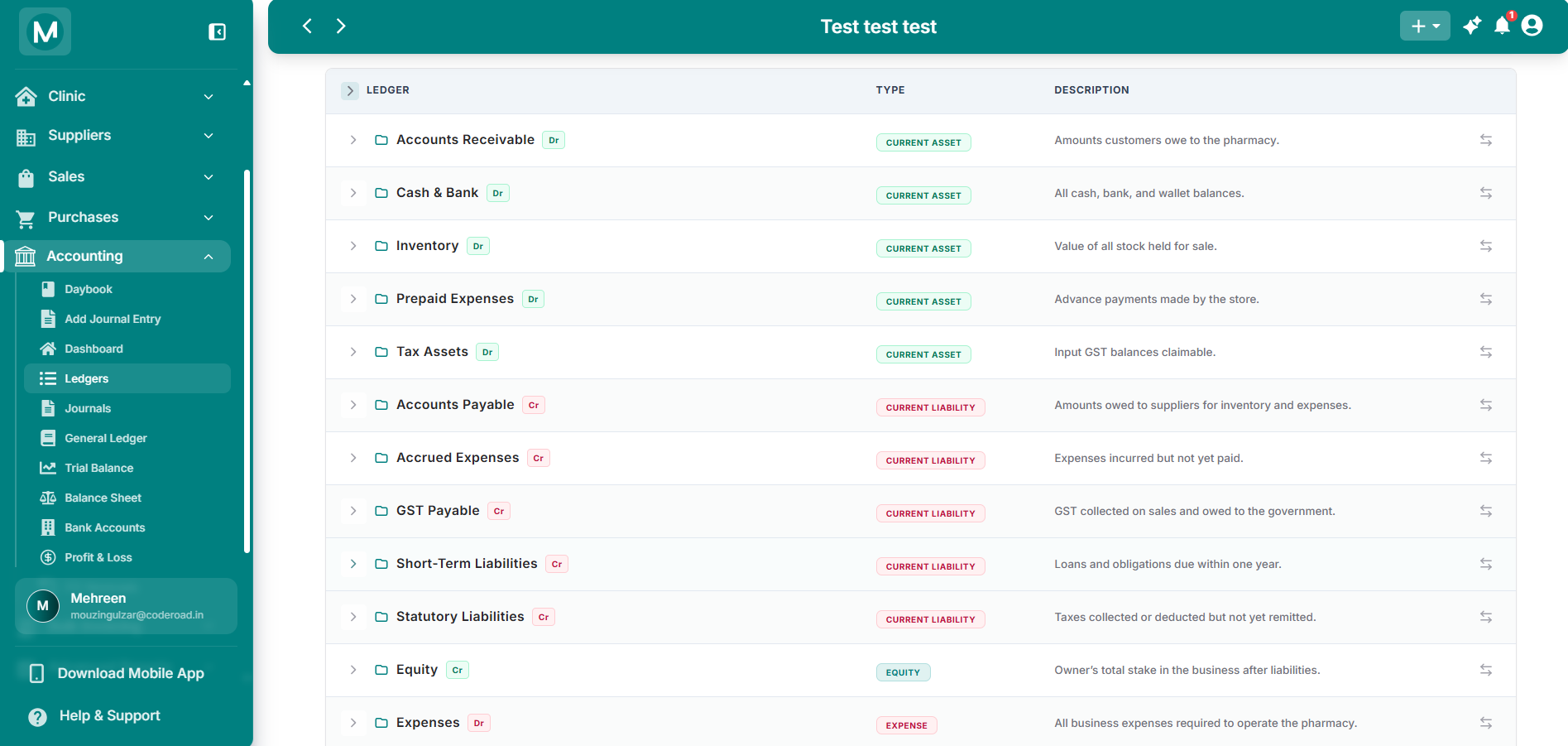
Parent Account Groups
The Ledgers showing some parent groups with their types.
Assets
Liabilities
Equity, Revenue, and Expenses
Child accounts
Child accounts are the actual accounts used in journal entries. Here is how the Cash & Bank parent expands:
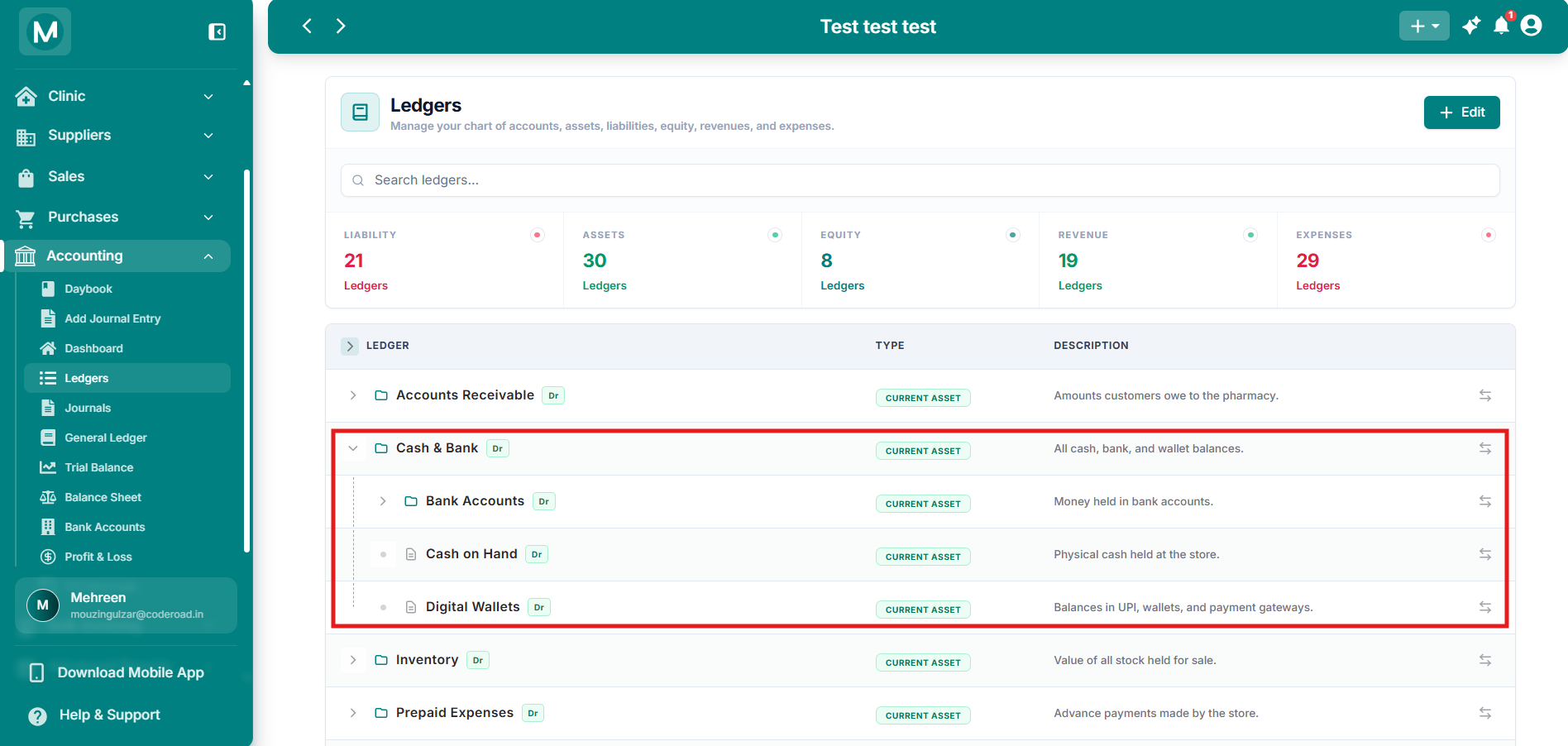
Cash & Bank Child Accounts
Expanded Cash & Bank parent showing nested child accounts.
Notice that Bank Accounts is itself a parent to individual accounts like Test Bank. This nested structure lets you see total bank balances at a glance while drilling into specific accounts.
Other typical child accounts
Accounts Receivable
- Customer Receivables: Outstanding credit bills
Inventory
- Drug Inventory: Medicines and healthcare products
- Non-Drug Inventory: Cosmetics and wellness items
Tax Assets
- GST Input CGST, GST Input SGST, GST Input IGST
GST Payable
- GST Output CGST, GST Output SGST, GST Output IGST
Equity
- Owner Capital: Investments by owners or partners
- Retained Earnings: Auto-calculated historical profits
Revenue
- Sales Revenue: Drug and non-drug sales
- Other Income: Commissions, rental income
Expenses
- Cost of Goods Sold: Direct inventory cost
- Rent, Salaries, Electricity, Transportation
GST in your books
MediFlux is built for Indian pharmacies, so GST is woven into every transaction.
Output GST (Liability)
Tax you collect from customers and owe to the government.
- CGST: Central GST on intra-state sales
- SGST: State GST on intra-state sales
- IGST: Integrated GST on inter-state sales
Input GST (Asset)
Tax you pay to suppliers. You claim this as credit against your output liability.
- GST Input CGST, GST Input SGST, GST Input IGST
Net GST Payable
Net GST Payable = Output GST - Input GST
If input exceeds output, the excess carries forward. MediFlux tracks this automatically and supports ITC Reversals for returned goods or adjustments.
Cash flow vs Profit
Profit and cash are not the same thing.
- Profit is an accounting measure. A credit sale increases profit immediately.
- Cash is what you have in the bank. You only receive cash when the customer pays.
You can be profitable on paper but run out of cash if:
- Customers delay payments on credit sales
- You hold too much inventory
- You pay suppliers faster than customers pay you
A healthy pharmacy needs positive operating cash flow. If you are selling stock but constantly short on cash, review your credit terms and inventory purchasing patterns.
Your financial statements
Once your accounts are set up, MediFlux generates three core statements automatically. Each one answers a different question about your business.
Profit & Loss Statement
Did I make money this month?
Balance Sheet
What does my business own and owe right now?
Trial Balance
Do my books actually balance?
Profit and Loss Statement
The Profit and Loss Statement, also called the Income Statement, tells you whether your pharmacy made or lost money during a specific period. It could be a day, a week, a month, a quarter, or a full financial year.
Formula: Revenue - Expenses = Net Profit / Net Loss
What goes into Revenue
Revenue is the total money earned from selling goods and services before any costs are deducted. In a pharmacy, this includes:
- Drug Sales: Income from prescription and over-the-counter medicines
- Non-Drug Sales: Income from cosmetics, wellness products, and medical devices
- Other Income: Commissions, rental income from clinic space, or service charges
Revenue includes both cash sales and credit sales. A credit sale counts as revenue even if the customer has not paid yet. This is why profit and cash are different things.
What goes into Expenses
Expenses are the costs you incur to generate that revenue. They are not the same as buying inventory. Inventory is an asset until it is sold. Expenses include:
- Cost of Goods Sold (COGS): The cost of the medicines and products you actually sold during the period. This is calculated as Opening Stock + Purchases - Closing Stock.
- Operating Expenses: Rent, salaries, electricity, transportation, marketing, and other day-to-day costs.
- Administrative Expenses: Phone bills, internet, accounting fees, and software subscriptions.
- Financial Expenses: Bank charges and interest on loans.
Gross Profit vs Net Profit
Gross Profit = Revenue - Cost of Goods Sold
Gross profit tells you how much you earn from selling stock before considering rent, salaries, and other overheads. A low gross profit means your buying price is too high or your selling price is too low.
Net Profit = Gross Profit - Operating Expenses - Other Expenses
Net profit is your bottom line. It is what remains after every cost is deducted. This is the number that matters most for understanding whether your pharmacy is truly profitable.
Why the P&L matters
- It shows trends: Are your expenses growing faster than your sales?
- It reveals margins: Is your markup enough to cover overheads?
- It guides decisions: Should you discontinue a low-margin product line? Can you afford to hire another staff member?
A positive net profit does not mean you have cash
The P&L includes credit sales as revenue and spreads asset costs over time. You can show a profit while struggling to pay suppliers. Always check your Cash Flow alongside your P&L.
Balance Sheet
The Balance Sheet is a snapshot of your business at a single point in time, usually the last day of a month or financial year. It answers one question: What is my pharmacy worth right now?
Formula: Assets = Liabilities + Equity
Assets on the Balance Sheet
Assets are listed in order of liquidity, meaning how quickly they can be turned into cash.
Current Assets (convertible to cash within one year):
- Cash in Hand: Physical cash at the store
- Bank Balances: Money in all business bank accounts
- Accounts Receivable: Money customers owe you
- Inventory: Value of unsold stock
- Tax Assets: Input GST you can claim back
- Prepaid Expenses: Advance payments like insurance premiums
Non-Current Assets (held for more than one year):
- Fixed Assets: Furniture, refrigerators, computers, shelves
- Deposits: Security deposits for shop premises or equipment
Liabilities on the Balance Sheet
Current Liabilities (due within one year):
- Accounts Payable: Money you owe suppliers
- GST Payable: Tax collected from customers, owed to the government
- Accrued Expenses: Bills received but not yet paid
- Short-Term Loans: Borrowings due within a year
Non-Current Liabilities (due after one year):
- Long-Term Loans: Bank loans or borrowings with repayment beyond one year
Equity on the Balance Sheet
- Owner Capital: The money you and your partners originally invested
- Retained Earnings: All profits from previous years that were not withdrawn
Working Capital
Working Capital = Current Assets - Current Liabilities
Working capital measures your ability to pay short-term bills. A positive number means you have enough liquid assets to cover near-term obligations. A negative number is a warning sign: you may struggle to pay suppliers or staff even if your P&L looks healthy.
Why the Balance Sheet matters
- It shows financial health: Are you building wealth or accumulating debt?
- It reveals leverage: Are you funding growth with loans or with profits?
- It helps with loans: Banks ask for Balance Sheets before approving credit.
- It tracks owner equity: You can see exactly how much of the business belongs to you.
Trial Balance
The Trial Balance is a list of every account in your Chart of Accounts with its current debit or credit balance. It is not a financial statement you share with outsiders, but it is the most important internal check in your bookkeeping.
Rule: Total Debits must equal Total Credits.
What the Trial Balance contains
Every account from your Chart of Accounts appears once, with its balance in either the Debit column or the Credit column:
- Asset accounts: Normally have debit balances
- Liability accounts: Normally have credit balances
- Equity accounts: Normally have credit balances
- Revenue accounts: Normally have credit balances
- Expense accounts: Normally have debit balances
If you add up every debit balance and every credit balance, the two totals must be identical.
Why the Trial Balance must balance
Remember the accounting equation: Assets = Liabilities + Equity.
In double-entry bookkeeping, every transaction hits two accounts with equal debits and credits. Over thousands of transactions, this balance must hold. The Trial Balance is the checkpoint that proves it.
What to do if it does not balance
An unbalanced Trial Balance means there is an error somewhere. Common causes include:
- A transaction was entered with only one side (single entry instead of double entry)
- A debit and credit were recorded for unequal amounts
- An account was classified under the wrong type (asset instead of expense)
- A balance was carried forward incorrectly from a previous period
- A rounding error in GST calculations
Never ignore an unbalanced Trial Balance
If your Trial Balance does not balance, your P&L and Balance Sheet will be wrong. Find the error before filing GST returns, applying for loans, or sharing reports with your accountant.
How MediFlux helps
MediFlux generates the Trial Balance automatically from your journal entries. Since most entries are created automatically when you record sales and purchases, the Trial Balance usually stays balanced. If you create manual journal entries, double-check that your debits and credits are equal before saving.
Common mistakes
- Confusing profit with cash: A credit sale boosts profit but not your bank balance until payment arrives.
- Mixing personal and business expenses: Record personal withdrawals as Drawings, not business expenses.
- Forgetting small cash expenses: Tea, stationery, and auto fares add up. Record everything.
- Ignoring GST on purchases: Enter the full bill amount including GST so input credit calculates correctly.
- Not reconciling bank accounts: Match MediFlux balances with bank statements monthly.
- Misclassifying account types: Wrong types break your Trial Balance.